
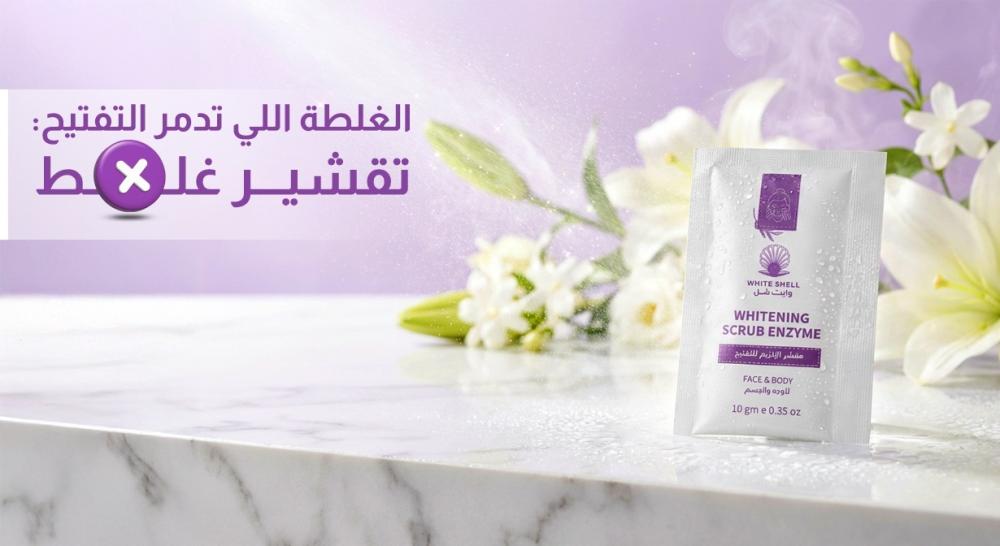
Why might exfoliation be the enemy of skin lightening rather than its supporter?
Skin lightening is a common goal for many women in the Gulf, especially with continuous exposure to the sun, high temperatures, and environmental factors that increase pigmentation and uneven skin tone.
But the irony is that the biggest mistake that destroys the results of the brightening process is not in the product itself, but in the method of exfoliation .
Improper exfoliation not only stops the lightening process, but may also:
- It doubles the pigmentation
- weakens the skin barrier
- It stimulates inflammation and excessive melanin production.
And here the vicious cycle begins: the more the skin is exfoliated violently, the darker it becomes.
This article explains the most dangerous common exfoliation mistakes , and why enzyme exfoliation has become the safest and smartest solution, especially for those looking for relapse-free brightening.
The first mistake: harsh exfoliation under the pretext of “quick results”
Among the most widespread practices:
- Using coarse exfoliants
- Rubbing the skin vigorously
- Excessive peeling
These methods give an immediate sense of cleanliness, but scientifically:
- micro-injuries occur in the skin
- It stimulates an inflammatory response.
- Pigment cells are prompted to produce more melanin as a defense mechanism.
And the result?
Darker skin instead of lighter .
Why does improper exfoliation cause pigmentation?
The skin is an intelligent organism.
When subjected to repeated abuse (rubbing, friction, strong peeling), it interprets this as a threat, and begins to:
- Increased thickness of the corneal layer
- Increase dye production
- Slowing down healthy cell regeneration
This is confirmed by numerous dermatological studies indicating that chronic inflammation is one of the main causes of pigmentation, especially in wheat-colored and brown skin, which is most common in the Gulf region.
The second mistake: confusing exfoliation with cleansing
Many believe that:
Anything that cleans hard = exfoliates well
This is incorrect.
Cleaning removes dirt.
Exfoliation, on the other hand, interferes with the cell renewal process .
Using strong cleansers or mechanical exfoliants on a daily basis:
- It disrupts the skin's balance.
- The protective barrier weakens
- It makes the skin more sensitive to the sun and pigmentation
Here's the smart solution: Enzyme Exfoliation
What is an enzymatic peel?
Enzyme exfoliation is a type of gentle exfoliation that uses enzymes to:
- Breaking down the bonds between dead cells
- Remove the dull layer without friction
- Stimulating the skin's natural regeneration
without:
- scratch
- rub
- inflammation
Therefore, it is considered the ideal choice for skin prone to pigmentation.
Why is enzyme peeling suitable for the skin of Gulf girls?
Because the skin type in the Gulf is often:
- It tends to pigment
- It is quickly affected by heat.
- It reacts strongly to rubbing and violence.
Enzyme peeling:
- Works quietly
- It does not raise skin temperature
- It does not stimulate melanin
This makes it a true brightening tool, not just a cosmetic step.
White Shell Enzyme Brightening Peel: The Difference in Formula
Why this product in particular?
White Shell Enzyme Brightening Peel is designed to solve a common problem:
How can I exfoliate my skin and maintain its brightening effect instead of damaging it?
The components and their scientific role:
Silicon dioxide (silica)
It helps to gently remove impurities and excess oils, without scratching the skin.
sodium bicarbonate
It supports deep skin cleansing and contributes to improving the overall skin tone.
titanium dioxide
It reflects light, giving the skin an instant glow and reducing the appearance of dullness.
Cocoyl sodium isethionate
A gentle cleanser derived from coconut, which maintains the skin's balance.
Dead Sea Salt
Rich in minerals, it promotes cell regeneration and provides a smooth texture without irritation.
This formula works harmoniously, not violently.
The third mistake: Incorrect timing of peeling
Even the best exfoliator can do harm if used at the wrong time.
Common mistakes:
- Exfoliate immediately before sun exposure
- Daily exfoliation
- Exfoliation on irritated or inflamed skin
Enzyme peeling is used:
- Once or twice a week
- On calm skin
- With a commitment to moisturizing afterward.
The correct way to use an enzyme peel (step by step)
- Gently cleanse the skin
- Apply an appropriate amount of the scrub
- Very light massage or just spreading
- Leave it as instructed
- Rinse it with lukewarm water
- Moisturize the skin directly
No rubbing.
No rush.
No excessive repetition.
Before/After: The Difference the Right Way Makes
Before incorrect peeling:
- falsehood
- Scattered pigmentation
- Uneven texture
After adhering to the correct enzyme exfoliation:
- serene glow
- More uniform color
- Smooth texture without allergies
The difference is not in strength, but in intelligence.
Why is this article important for anyone looking for real skin lightening?
Because it does not promote an illusion, but rather:
- Corrects a misconception
- It protects you from wasting your skin lightening efforts.
- It puts you on the scientifically safe path
And most importantly:
It reminds you that skin doesn't need to be treated harshly to change.
In conclusion: Skin lightening doesn't work with the wrong type of exfoliation.
If you are suffering from:
- Non-fading pigmentation
- Lightening that does not last
- Adverse results after peeling
ﻻ
Perhaps the problem is not with your skin, but with the method of exfoliation.
Enzyme peeling is not a luxury, but a conscious choice that respects the nature of the skin, especially in the Gulf climate.
Start by correcting the mistake, and let the brightening happen as it should.
Recommended product:
Enzyme peel for brightening – White Shell
A smart, gentle, and convenient solution for lightening without setbacks.