
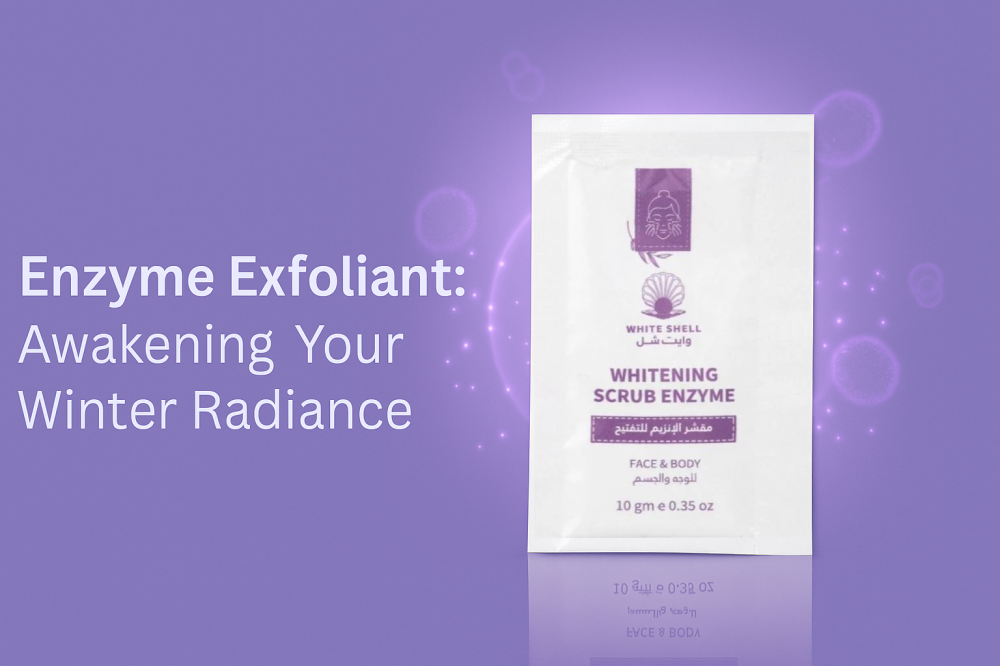
Winter is coming… and the cold weather is starting to show on the face first: dryness, dullness, a rough texture, and skin that needs revitalization. At this time, moisturizing alone isn't enough; dead skin cells on the surface prevent the skin from breathing and reduce the ability of moisturizers and lotions to penetrate deeply. This is where an enzyme peel comes in – a gentle yet effective option that meets the skin's needs without stressing it or causing excessive irritation.
White Shell's Enzyme Peel for Brightening , formulated with silica, Dead Sea salt, titanium dioxide, and sodium bicarbonate, exemplifies the fusion of science and aesthetic convenience. This article explores how the enzyme peel works, the benefits of its ingredients, how to use it safely in the fall, and why it's a top choice in the global beauty trend.
What is an enzyme peel and why is it good for your skin in the fall?
An enzyme peel is a type of mild chemical peel that uses natural enzymes (or substances that stimulate mild oxidation or exfoliation) to cleanse the skin of dead cells without the need for harsh mechanical scrubbing. Its characteristics include:
- Relatively gentle on sensitive skin compared to strong acids or harsh physical exfoliants.
- It gently penetrates the upper layer of the skin, facilitating cell renewal and improving skin radiance.
- It balances the removal of dead cells with the preservation of the skin's natural barrier, which is especially important in seasons like autumn and winter—when skin is more prone to dryness and erosion.
A recent review in the Journal of Cosmetic Dermatology showed that proteolytic enzymes such as papain, bromelain, and viscerol provide effective exfoliation with better tolerability compared to some acids, provided the formula is stable at the correct pH and does not contain additional irritants.
White Shell Enzyme Peeling Ingredients: The Formula and What It Does for Your Skin
Product link: Enzyme Peel for Brightening – White Shell
Here is a list of the ingredients that make up this scrub and their personal benefits:
These ingredients, when combined in an enzyme formula or with enzyme catalysts, work together to remove dead cells, brighten skin tone, and improve texture without feeling dry or strongly irritated.
How does this exfoliator work enzymatically even though it does not contain explicit enzymes?
Although the White Shell brightening scrub formula does not mention enzymes such as papain or bromelain, its ingredients work in a way that supports the application of an enzyme or mild enzyme peel:
- Reducing skin friction : Silica and Dead Sea salt help to gently remove dead cells without harsh rubbing.
- Improved absorption of the following products : Thanks to the cleansing and purifying of pores, the skin becomes more responsive to masks and moisturizers after exfoliation.
- Visible and rapid brightening : Using titanium dioxide with sodium bicarbonate enhances visible brightening and glow instantly.
Scientific evidence: Studies confirm the effectiveness of enzyme peels compared to acids
- Randomized Controlled Trials comparing enzyme formulations and glycolic acid have shown that enzyme peels reduce pigmentation and improve color clarity to near-perfecting results with acids, but with less irritation.
- A review in J Cosmet Dermatol details the clinical uses and potential side effects of enzymatic peels, and emphasizes that pH control and formulation stability are very important.
Steps to use White Shell Enzyme Exfoliator safely and effectively in autumn and winter
Here's a practical routine designed to give your skin a winter glow without dryness or damage:
- Initial glyco test : Apply a small amount behind the ear or on the lower jaw for 24 hours to check for an allergic reaction.
- Pre-cleansing : Use a gentle cleanser to remove makeup and oils; clear skin responds better to exfoliation.
- Apply the scrub : Gently rub the scrub in light circular motions for one to two minutes, then rinse with lukewarm water.
- Deep hydration : Immediately after exfoliating, apply a rich moisturizer to support the skin barrier.
- Use sunscreen in the morning: because sun exposure after peeling makes the skin more prone to pigmentation and sensitivity.
It is preferable to use it once or twice a week in the fall, and it can be used more frequently in the winter, while monitoring the skin's response.
Before and after experience
Maryam, one of the real users:
"I used the White Shell Enzyme Scrub once a week during the fall, and after three weeks I noticed that my skin was smoother, the dark spots were a little lighter, and the overall appearance was brighter. I didn't feel the usual dryness; on the contrary, my skin's hydration improved because the moisturizer I used with it absorbed better."
Dermatologist's opinion
Dr. Sarah Al-Harthi, a dermatology and cosmetic specialist, says:
"Enzymatic peeling is an excellent option for those who want a natural glow without the risk of redness or irritation that often accompanies the use of strong acids. White Shell's formula, which combines silica, sea salt, and titanium dioxide, gives a double result: gentle exfoliation + visible brightening + improved texture. With a focus on post-peel hydration, it can be safely used several times in the cold season."
What is the difference between an enzyme peel like this and chemical or physical peels?
In conclusion
If you want skin that glows in autumn and winter without dryness or irritation, White Shell Enzyme Peel is a wise choice that combines effectiveness with gentleness. Its carefully formulated blend makes it ideal for removing dirt and dead skin cells, visibly brightening, and improving skin texture.
Don't wait until dullness sets in—start today. Try White Shell 's Brightening Enzyme Peel and give your skin the glow it deserves this season.
Scientific references
- Trevisol, TC, Henriques, RO, Souza, AJA, Furigo Jr., A., “An overview of the use of proteolytic enzymes as exfoliating agents”, Journal of Cosmetic Dermatology , 2022. ( PubMed )
- Mekas, M., Chwalek, J., MacGregor, J., Chapas, A., “An Evaluation of Efficacy and Tolerability of Novel Enzyme Exfoliation Versus Glycolic Acid in Photo-damaged Skin”, J Drugs Dermatol. , 2015. ( jddonline.com )
- “Proteolytic Enzyme Activities of Bromelain, Ficin, and Papain...”, Applied Sciences , 2025. ( MDPI )
- “Silica-based microencapsulation used in topical dermatologic...”, PMC , 2023. ( PMC )
- “Use of silicon for skin and hair care: an approach of chemical forms ...”, PMC , 2016. ( PMC )